
Cedar Rapids Court Docket Searches
Cedar Rapids is a village. It has no village court search, no municipal judge, no citation lookup, and no local calendar of its own. So where do you look? Pick Boone in the Nebraska Judicial Branch case-information service. A Cedar Rapids ordinance or traffic matter most likely sits in County Court. The same statewide JUSTICE system runs a District Court search too, when the case belongs at that level. The village name is helpful context, but the public interface filters by county, not by city.
- Use the official JUSTICE search route and agree to the one-time search terms.
- Enter the party name with the correct Individual or Entity selection.
- Narrow the search to Boone, then add a case year or court type only as needed.
- Check the displayed court, case number, type, and Register of Actions.
- If no result appears or the date is urgent, use the calendar and call the Boone court clerk.
Two limits are worth knowing before you search. The state service reports a 24-hour entry lag. It also returns a maximum of 30 results before you must narrow further. Older material can also depend on when the county's historical systems were installed. For a free electronic option, the courthouse terminal is the documented alternative.
Cedar Rapids Village and Court Register
Village agendas and minutes serve their own purpose. They can record board action, ordinance adoption, or local contact details for Cedar Rapids. They are not Register of Actions entries. A court register, by contrast, tracks the complaint, hearing, order, judgment, and related public financial events on a filed case. The difference matters in practice: a board minute may explain why an ordinance exists, yet it will not show whether any Cedar Rapids citation was issued or how a court case ended. The official Cedar Rapids village site publishes the municipal contact and meeting material.

The village site covers local government, while court activity lives in the statewide Boone court record.
- Case type
- The broad JUSTICE classification, such as traffic, criminal, civil, juvenile, or probate.
- Case subtype
- A narrower court classification that helps explain the case type.
- Setting
- A scheduled court event that can change through a continuance or reset.
Inside the Cedar Rapids Municipal Court
No separate Cedar Rapids municipal court operates here. Under Nebraska law, a village ordinance complaint is prosecuted in county court. That routing saves you from a dead-end search: go to the village for ordinance or board material, and to Boone County Court for the judicial complaint and case record. The court's reliance on state systems does not turn the village office into a clerk counter. Neb. Rev. Stat. § 25-2703 bridges the two worlds. It requires the current ordinance to be on file with the county court before prosecution. That filing is what links a Cedar Rapids village rule to the Boone court case path.
Cedar Rapids Online and Court Counter
The Cedar Rapids website describes the village's rural location and access routes. But it offers no court-record system. Online state access and the Albion court counter are therefore two different paths, each with its own use. Start online when you already know the case number or party name. Need a certified copy, a missing image, or an answer on a restricted record? Call the court office rather than assuming Village Hall keeps a court copy. The village site lists City Hall contact and hours, but those are not court-counter hours. For the Boone court, the contact is Lisa Langan at 222 South 4th Street, Albion, Nebraska 68620, 402-395-6184. Call before making the trip. The village publishes no route, parking, or service-time details tied to a court request. So a quick phone call is the safe move.
Boone Court Records Counter
Lisa Langan
222 South 4th Street
Albion, NE 68620
402-395-6184
Finding Cedar Rapids Court Dates
For Boone County Court or Boone District Court dates, use the Multi-Court Case Calendar. The search accepts a current or future date, or a last name with at least two letters. The service does not publish a Cedar Rapids-specific row layout, courtroom list, or recurring docket-call schedule. One caution: an empty result is not proof that no Cedar Rapids hearing exists, because entries can lag. Treat a blank search as incomplete, not final.
| Court selection | Select County Court for a village ordinance or traffic matter, then choose Boone. |
|---|---|
| Date range | Current and future dates only; the calendar is not a historical hearing archive. |
| Last-name search | Use at least two characters and the court-record spelling. |
| Case date | Compare a calendar date with the citation, notice, order, and newest register entry. |
| Changed setting | A continuance or reset changes the event. Confirm a conflict with the court clerk. |
A village board schedule is a Cedar Rapids government event, not a judicial setting.
Cedar Rapids Citation Court Steps
Start with your Cedar Rapids citation. It is the best opening for a local traffic or ordinance case. Keep it safe, then figure out whether the offense is waiverable. The practical sequence runs like this: citation in hand, statewide payment-eligibility check, and payment or appearance as required. After that comes JUSTICE case follow-up. A clerk request covers any court document you need. A city agenda search plays no part in that workflow.
Lost the citation? Facing a warrant or a suspension notice? Call the Boone court directly. An online payment may reach your account without posting the same day. It will not recall a warrant. The court, not Cedar Rapids Village Hall, controls the records route.
Cedar Rapids Traffic Ticket Lookups
Traffic cases from Cedar Rapids travel the county-court route. The underlying rule may still come from the village. The state Citation Payment service handles only eligible waiverable citations. You need the actual citation to proceed. It is a statewide tool, not a village docket. Once public information is available, JUSTICE supplies the related court record.
A court record and a driver record answer different questions. For the citation, hearing, court judgment, costs, payments, or warrant status, use Boone County Court. For driver history, follow the state licensing agency's instructions. The Boone traffic court page lays out the countywide court-record distinctions.
Cedar Rapids Code in County Court
Village paperwork has its own job. It can name the ordinance in question or show the date a board passed local legislation. When a case becomes a prosecution, the current ordinance gets filed with county court. The city-and-village ordinance rule drives that filing. That filing step does not turn every village document into part of the court docket. Someone chasing the case record should follow the court path. Someone who just needs the rule's text should start with the official village source. Ask the right government office when the code link comes up short.
The same divide explains why Cedar Rapids has no separate court fee sheet. It also has no court document request form. Need a Boone court document? The state CC 3:29 court-copy process is the way.
How Cedar Rapids Cases Reach County
Traffic tickets, ordinance cases, misdemeanors, probate, and small claims tied to Cedar Rapids generally start in Boone County Court. That applies when the court has jurisdiction. Felony trials, large civil disputes, and domestic-relations matters may land in Boone District Court instead. No village population count or map line creates a second court system. Court level, case type, and the record itself make the call. The result shows up on the docket.
Docket flow: Cedar Rapids ordinance or citation › Boone County Court › Boone District Court when jurisdiction requires it › Nebraska appellate courts if an appeal is filed.
Check the court and case subtype in JUSTICE before deciding a Cedar Rapids matter sits in one court or the other. A quick look at the docket entry saves a wrong trip.
Cedar Rapids Village Hall Contacts
The official village source lists City Hall contact details and points to agendas and minutes. For a municipal record question, that is a sensible local route. It is no substitute for the court clerk. A court-file request runs through a different office. It faces different public-access limits and can carry its own fee and certification steps. The court office handles Register of Actions questions, available paper files, certified copies, and digital audio. Transcripts round out the list. The Boone County Clerk page shows the county's administrative records side, and it makes clear why those records and trial-court records belong with the office that actually holds them.
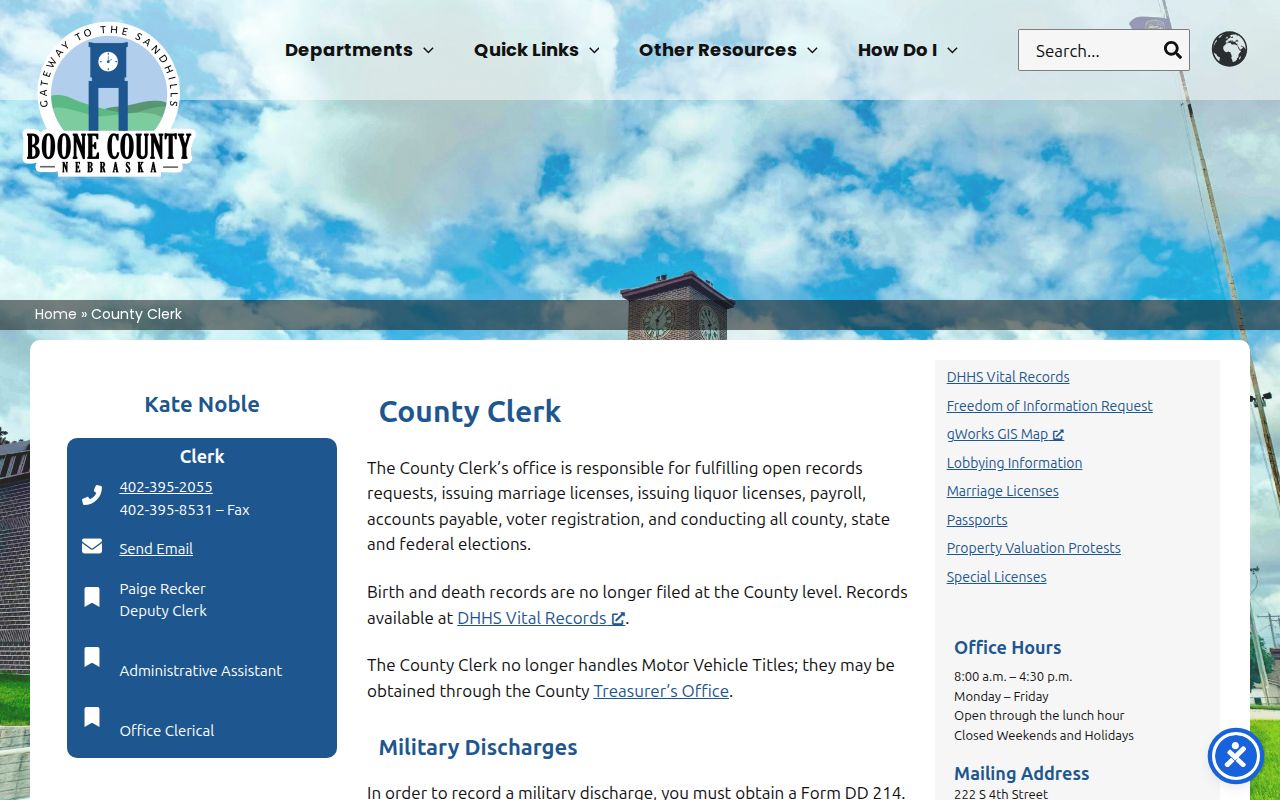
The county administrative side helps with routing, but Lisa Langan's court office is the contact for the docket and any court file.
Who Can See Cedar Rapids Court Records
Nebraska court-record rules govern what the public can see of Cedar Rapids court records. Electronic public information may include a party index, case summary, public parties, the Register of Actions, calendar fields, and judgments. Available images may appear too. Restrictions still apply. A case can appear on the docket. A document may sit sealed, redacted, protected, unconverted paper, or simply not imaged. Juvenile and adoption materials call for extra care and should never be assumed public.
Key Rules:
Neb. Rev. Stat. § 84-712 expresses Nebraska's public-record access policy, subject to exceptions.
Neb. Ct. R. § 1-805 identifies public electronic court information.
Neb. Rev. Stat. § 25-2703 sends village ordinance prosecution to county court.
Cedar Rapids Court Copy Request
Cedar Rapids filings go through the court clerk. A Boone court order, judgment, complaint, or other specific filing tied to Cedar Rapids uses CC 3:29. Name the court and county. Give the case number or case name, the document title or date, and your delivery preference. Add your contact details and whether you want a certified copy. The options cover electronic non-certified, mailed non-certified, electronic certified, and mailed certified, each with its own fee language. Check the current amount before you send money.
Figure out the product first. A Cedar Rapids ordinance-text request belongs with the municipal source. A board-action question belongs with village agendas or minutes. A case-status question belongs with the Boone court register. A court-copy question belongs with the clerk. The sequence matters. The official Cedar Rapids site holds municipal information but offers no court search. A rule or board action may show up online. The county court may still be needed for a citation, a court date, a public judgment, or a certified document.
When a Cedar Rapids case will not appear, start with the basics. Recheck the spelling, the Individual or Entity choice, the Boone filter, the court type, and any entry lag. If the record still hides, narrow the request by case number, document name, and date. Ask the Cedar Rapids court clerk. The clerk can explain whether a file is public, restricted, sealed, unconverted paper, or just not an available image. A missing village search link proves nothing about the court file. The two records travel through separate public channels.
A case search and a copy request do different jobs. The search finds the court, case number, type, and event history. The clerk-copy route produces the actual filed document when it is public and available. An online record is not automatically certified. A search fee is not a copy fee. It is not a seal fee, a transcript fee, or a digital audio fee either. Keep that distinction in mind before driving from the village to the Albion courthouse.
A search result helps you locate a case, but it carries no authentication. Digital audio and a typed transcript are separate products. The clerk can lay out the request path for the particular court file.
Note: Cedar Rapids municipal records and Boone court records answer different questions, even when both concern the same ordinance or local event.