
St. Edward Court Docket Searches
St. Edward offers no official city-court docket, no city judge listing, and no city-case filter. So go straight to the Nebraska Judicial Branch case-information service for the Boone trial-court record. County Court is the right starting point. An ordinance, traffic, misdemeanor, small-claims, or probate matter all begin there. District Court applies only when the case level demands it. Boone is the county selection in the state record. So don't expect the St. Edward name to appear in a court dropdown. The city simply isn't a filter there.
- Open the state JUSTICE route and agree to its search terms.
- Search the party name as an Individual or Entity, based on the court record.
- Select Boone and narrow by year or court type if the result set is broad.
- Check the case type, subtype, court, number, and Register of Actions.
- Use the state calendar or call the court clerk when a St. Edward setting is time-sensitive.
The one-time service charges a fee, even when a search comes back empty. Entries can also lag by at least a day. For a no-charge electronic option, the courthouse JUSTICE terminal is the documented public route.
St. Edward Code Is Not a Docket
The city's legal-notices material lists its ordinance chapters. Those include vehicle and traffic, misdemeanors, public ways, utilities, and regulations. That helps you find the local rule. What it can't tell you is whether a citation issued. It also can't say whether a case was filed, or what a court decided. Those are Boone County Court questions. The answers sit in the case register and case file once a prosecution begins. St. Edward's official legal-notices page is the local ordinance source.
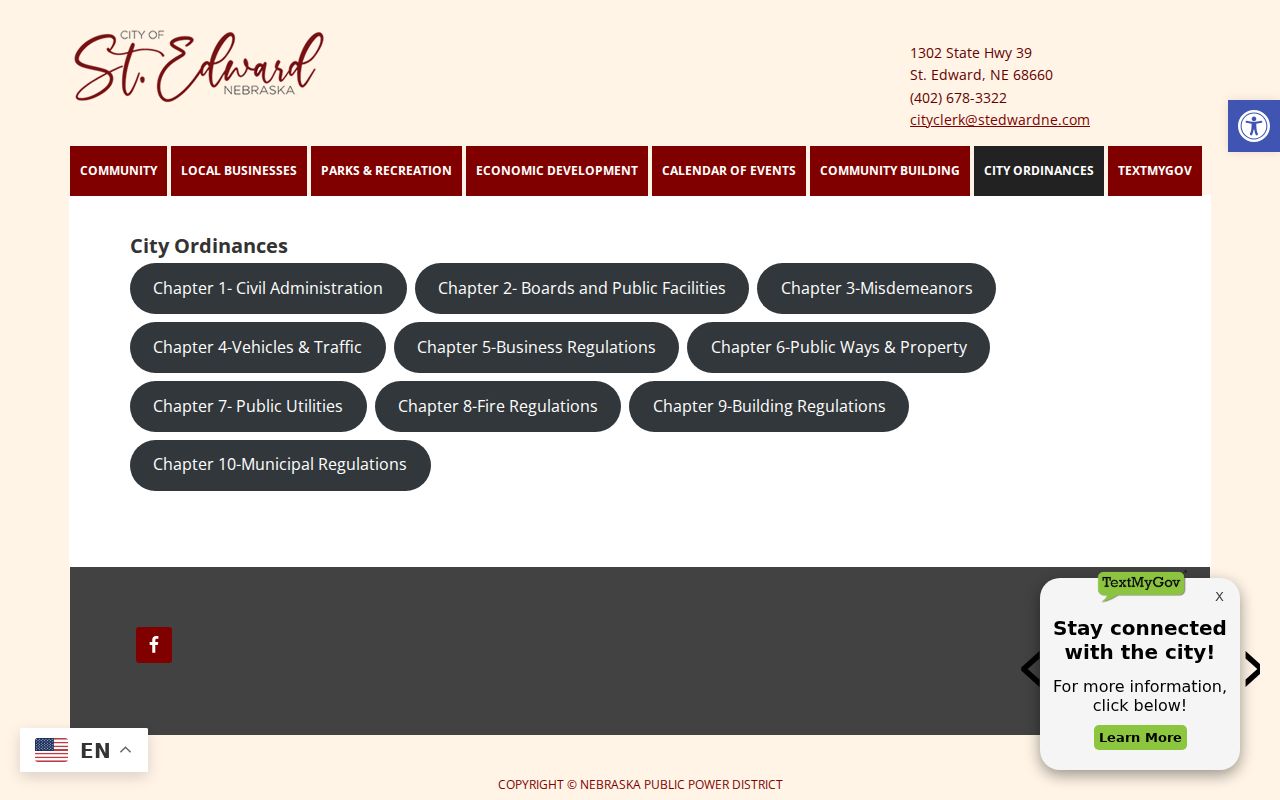
Ordinance source, not court record: the legal-notices page supplies city law context, and no city chapter converts into a Boone County court docket entry.
- Citation
- A ticket or charging document that may begin a traffic or ordinance case.
- Register of Actions
- The chronological official case activity summary.
- Judgment
- A court decision or order, not a city ordinance provision.
Inside the St. Edward Municipal Court
Nebraska runs no separate St. Edward municipal court with a public municipal docket. Under the state's city and village ordinance rule, prosecutions go to county court. The current ordinance must be on file there. That draws the useful line for St. Edward. The city holds the rule. Boone County Court holds the complaint, the hearing, the court costs, the judgment, and the public register. Neb. Rev. Stat. § 25-2703 is that routing authority. It doesn't turn a city council calendar into a court calendar. Nor does it turn a city office into a court-records counter.
St. Edward City Calendar and Court
The St. Edward city calendar tracks council meetings and public events. Case numbers, captions, judges, and hearing-status filters simply aren't on it. A meeting date can matter for local government business, sure. But it proves nothing about a court appearance. Keep the two calendars separate. Do that when you're tracking a St. Edward ordinance or traffic matter. The official St. Edward calendar shows the municipal event lineup.
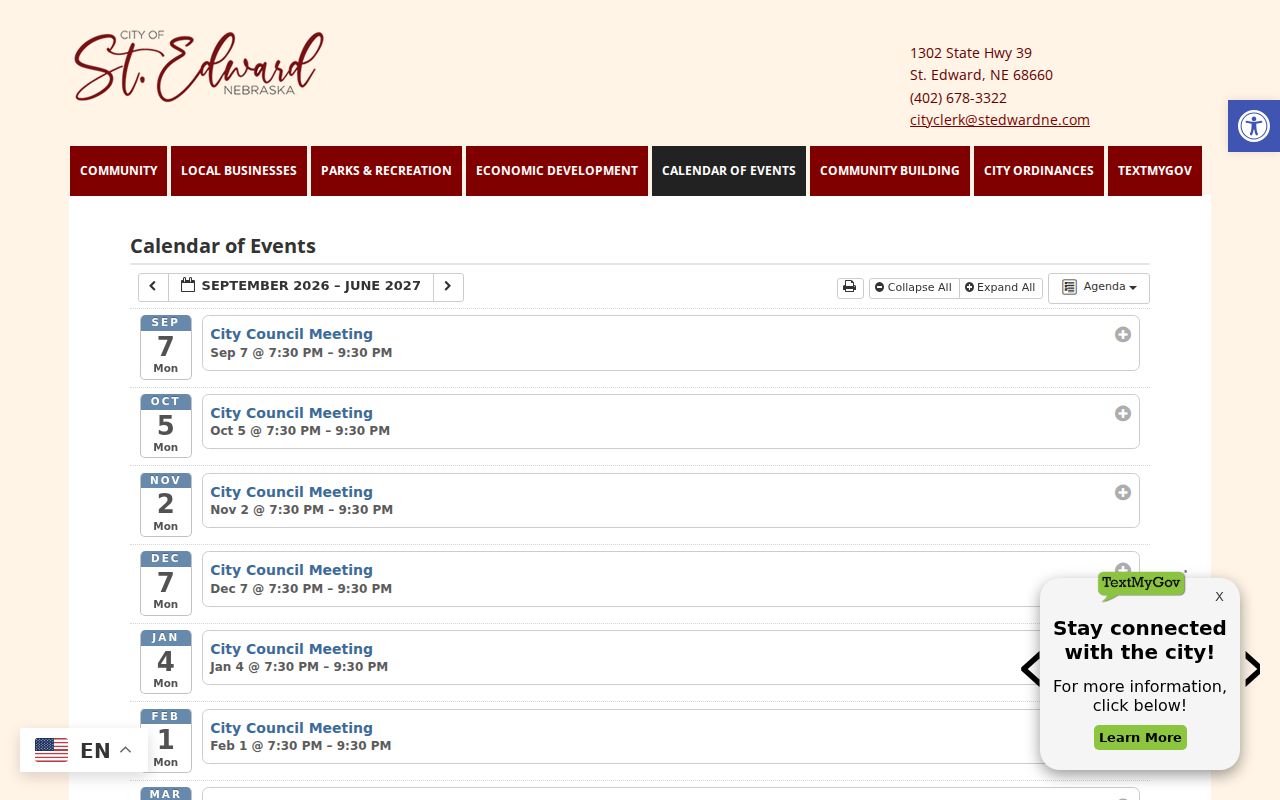
Use the city calendar for municipal dates. For a hearing setting, the state court calendar is the search that counts.
Finding St. Edward Court Dates
For a St. Edward case, open the Multi-Court Case Calendar, choose County Court or District Court, then Boone. You can search by a current or future date, or by a last name of at least two characters. One caution from the official calendar itself: timely entry isn't guaranteed, and an empty result doesn't always mean no date exists. So read the citation or current order first. Then ask the court clerk about any continuance or urgent setting.
| County selection | Choose Boone, not St. Edward, after selecting the court type. |
|---|---|
| Date mode | Current and future setting dates only, not a historical hearing archive. |
| Name mode | Last-name search with at least two characters. |
| Case event | A setting is scheduled court activity; it is not necessarily a final trial or disposition. |
| Changed date | A reset or continuance moves the event. The newest order or clerk confirmation controls. |
The city calendar never replaces a citation date, a court notice, a register entry, or a direct call to the clerk for confirmation.
St. Edward Public Safety Is Not Court Clerk
St. Edward's emergency-services source describes a building. It brought the fire hall, city offices, and police department together during 2006 and 2007. It's local public-safety context. Treat it as such, not as a court annex or records office. Court records for a St. Edward matter stay with the Boone trial-court clerk in Albion. Don't send a request for a judgment or register to city staff. The services share a building, but that's all. St. Edward's emergency-services page documents that service setting.
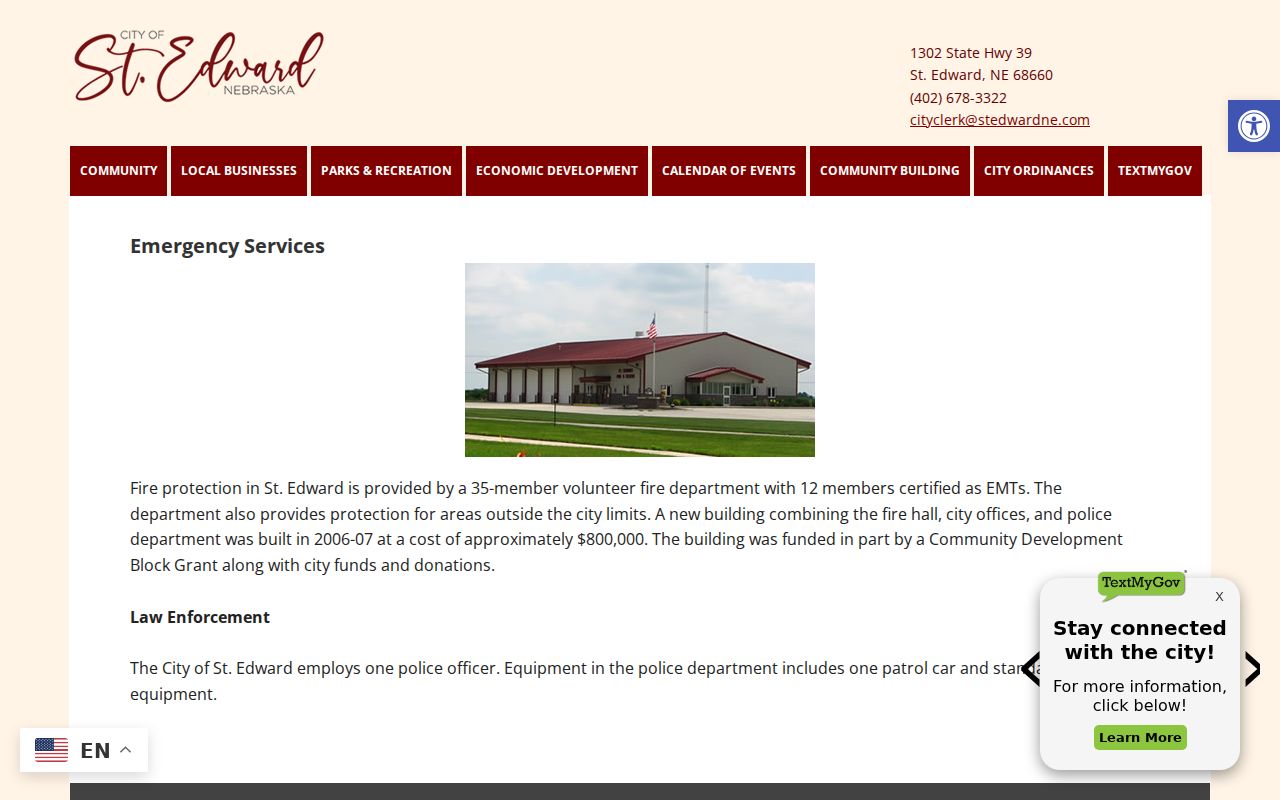
Building, not records office: knowing where the city services sit doesn't change who holds the Boone court file.
St. Edward Traffic Ticket Lookups
A St. Edward vehicle or traffic ordinance gives you the rule text. But the citation's court path still runs through Boone County Court. Keep the citation handy. Use the state Citation Payment service only when the citation is waiverable and eligible. That's a statewide service. It is not a St. Edward city payment portal. And paying there isn't a court outcome; that still takes the related court record. When appearance is required, the citation date controls unless the court moves it. A lost citation, a payment problem, or an urgent status question needs help. Call Lisa Langan's Boone court office at 402-395-6184. For the countywide picture, see the Boone traffic court record page.
St. Edward History Outside Court Records
St. Edward keeps its past in city records, not court files. The town grew from a Beaver Valley settlement. It was platted in 1872, and took its name from Rev. Edward Sorin. A flood in 1884 brought the dike story that locals still tell. None of that points to an old St. Edward court docket. The city never kept one separate from the county. A council calendar tells you about meetings. It says nothing about a pending case or a court setting.
For the local story, St. Edward's history page is the official word on the town's early years. It covers exactly that: the settlement, the plat, and the flood.
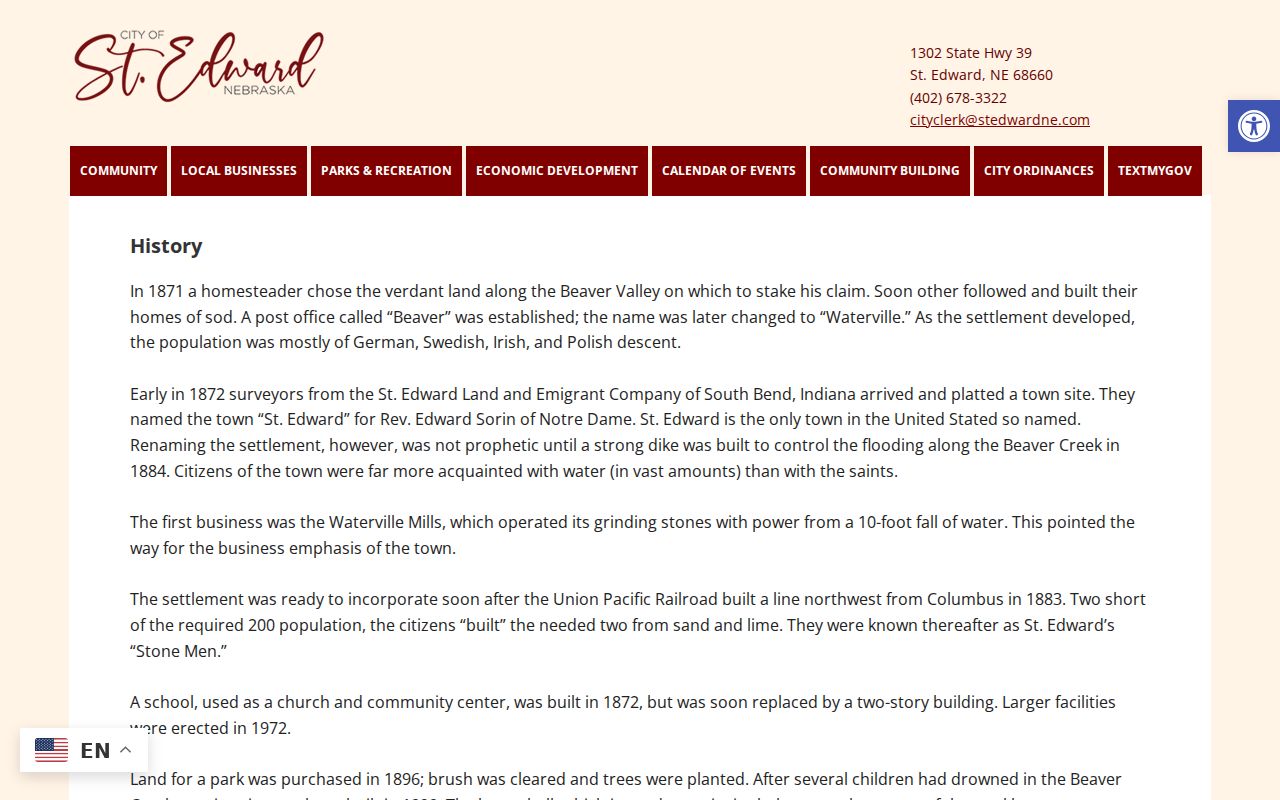
History sets the scene. The court register alone records the judicial events.
How St. Edward Cases Reach the County
St. Edward has no city trial court of its own. An ordinance, traffic, or misdemeanor case that fits county-court jurisdiction lands in Boone County Court. A general-jurisdiction matter can go to Boone District Court instead. Either way, one office holds the file. Staff at the shared Albion courthouse keep the court records. Where the conduct started does not change the docket's home.
Docket flow: St. Edward ordinance or citation › Boone County Court › Boone District Court when the subject requires that court › Nebraska appellate courts if an appeal is filed.
Check the JUSTICE court type and subtype, not the city label, when deciding which record to pull.
St. Edward Code and Case Outcome
Keep your sources straight in St. Edward. Legal notices give you the ordinance category, the city calendar covers public meetings, and public-safety pages describe municipal services. For an actual court case, turn elsewhere. JUSTICE, the state calendar, or the Boone court clerk hold the answer. The split matters when all you hold is an ordinance chapter or a meeting notice. Neither one carries a case number, a judicial setting, payment status, a dismissal, or a judgment. Only the court register may show those.
Boone Court Records Counter
Lisa Langan
222 South 4th Street
Albion, NE 68620
402-395-6184
St. Edward City Hall lists its own contact for ordinance and municipal questions. That is not the clerk's certified-copy counter.
Who Can See St. Edward Court Records
Boone trial-court rules govern access here. St. Edward court records sit under the same Nebraska electronic-access rules as any other case in the county. Public information can cover indexes and case summaries. It also reaches public party information, Registers of Actions, available images, calendars, and judgment material. A listing does not guarantee an unrestricted document image. Sealed, redacted, protected, juvenile, or unconverted paper material may stay out of public electronic reach.
Key Rules:
Neb. Rev. Stat. § 84-712 favors public access subject to statutory exceptions.
Neb. Ct. R. § 1-805 lists public electronic court-record fields.
Neb. Rev. Stat. § 25-2703 places city ordinance prosecution in county court.
St. Edward Court Record Sources
Need an actual document from a St. Edward case file? The CC 3:29 court-copy process is the way to get it. Tell the clerk the court and county. Give the case number or party name too. Name the document and its date, and say how you want delivery. State whether the copy must be certified. Keep the lanes straight here. A St. Edward ordinance chapter is a city matter. That question belongs with the city's legal-notices source. Council dates and public events belong on the city calendar. Anything tied to a complaint, hearing, Register of Actions entry, judgment, or court cost belongs to Boone County Court. When a city page and a court search both seem to touch the same local rule, this split saves real confusion. St. Edward city offices can explain municipal records. Only the court clerk can explain the copy path for a court file.
A simple sequence works well for a St. Edward ordinance matter. Start by finding the chapter or legal notice that supplies the rule. Then preserve the citation or court notice itself. A city event listing is not a dependable stand-in. Next, search the Boone County court docket by party name or case number, noting the court type and subtype shown. A St. Edward court date may be close. If so, compare the citation, any current order, the Register of Actions, and the state calendar before you act. Need a specific document? Give the clerk its title and date. Keep the ordinance text, the public calendar, the citation, and the court file in separate lanes. That also prevents treating city payment or utility functions as a court-payment system.
Know the limits of the court-copy route before sending a request. Electronic access can surface public case information through an authorized provider or a courthouse terminal. Paper records that were never converted sit outside that electronic rule. A filing can be public. Its image may still be unavailable, redacted, or restricted. The Register of Actions is a chronological event summary, not a hearing transcript. Case detail can show an outcome, court, and judge without displaying every exhibit or filed paper. Sealed or protected documents are governed by the court's access rule and the clerk's direction. For an ordinary public copy, one distinction matters. A non-certified file copy differs from a certified copy bearing the clerk's authentication. Typed transcripts and county-court digital audio records follow separate production routes. State materials describe digital audio as something other than the official court record. A city ordinance page does not authenticate a court document. A JUSTICE result is not itself a certified copy. These distinctions help you request what you actually need instead of mistaking a general search result for proof or a complete file.
Call ahead before traveling. Published court-hour information conflicts across sources. A paper file may never appear in the public electronic record. A transcript or digital audio request is a separate product from an ordinary court copy.
Note: St. Edward's local sources help identify city law and public events, while the Boone court clerk controls court-file access and certification.